
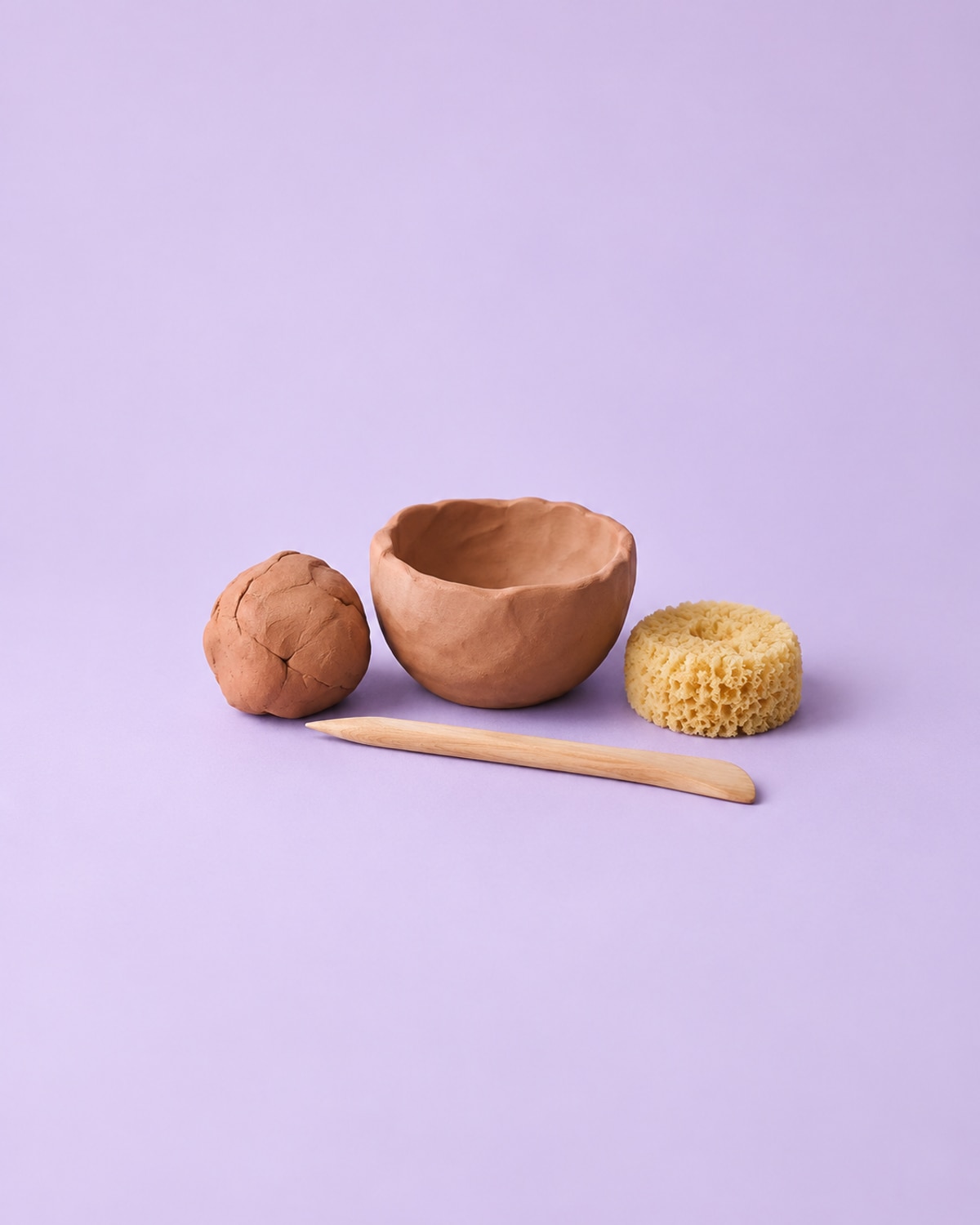
Clay is just wet earth. Shape it and let it dry, and it crumbles back to dust the first time it rains. Put it in a fire, though, and it changes for good. It becomes ceramic, hard as stone, and it can last for tens of thousands of years.
The oldest fired clay
In 1925, archaeologists digging at Dolní Věstonice, in what's now the Czech Republic, found a small clay figure about 11 centimetres tall. She was made between 29,000 and 25,000 years ago and fired at around 500 to 800°C, in an early kiln or hearth. With a few other pieces from nearby, she's the oldest known ceramic in the world.
She wasn't alone. The same camp held clay animals and more than 2,000 little balls of fired clay. Many of the figures cracked or burst in the fire, and some archaeologists think that was the point: wet clay, thrown into the flames to see what happened.
The first pots
For a long time, people thought pottery arrived with farming, about 10,000 years ago. Then came Xianrendong Cave, in Jiangxi, China. Pieces of pots there date to 20,000 to 19,000 years ago, and some still carry scorch marks from sitting over a fire. Ice age hunters and gatherers were cooking in clay long before anyone planted a field.
People were cooking in clay pots 10,000 years before anyone planted a field.
The wheel
For thousands of years every pot was built by hand, often from coiled ropes of clay. By around 3500 BCE, potters in Mesopotamia were turning their work on a wheel. Later came the fast wheel, a heavy stone that kept spinning on its own, so a potter could throw a whole pot from one lump of clay. Jars and bowls became cheap enough for everyone.
Hotter fires, finer clay
The hotter the kiln, the harder and glassier the pot. Chinese potters pushed their kilns hotter than anyone, and by the Tang dynasty (618 to 907) they were making porcelain: white, fine and so dense it rings when you tap it.
Europe spent centuries trying to copy it, and only cracked the secret in about 1707, in Saxony. Marco Polo called it porcellana, after a glossy little sea shell. In English we still just call it china.
Still made by hand
A clay studio today runs on the same three things as that camp in Moravia: earth, water and fire. Pinching, coiling and throwing are still how it's done. A mug from a small studio is made the way people have made things for 20,000 years.
Sources
Science (2012): Early pottery at 20,000 years ago in Xianrendong Cave, China
Harvard Magazine: 20,000 year old pottery (harvardmagazine.com)
History of Information: the Venus of Dolní Věstonice (historyofinformation.com)
Wikipedia: Venus of Dolní Věstonice, and the Dolní Věstonice site
World History Encyclopedia: Mesopotamian inventions (worldhistory.org)
Wikipedia: Potter's wheel, and Porcelain
Britannica: Porcelain (britannica.com)